Tuesday, December 5, 2017

carlos santana history


Mexican-American honor winning guitarist Carlos Santana is pioneer of Santana, a band whose music particularly mixes Latin-injected shake, jazz, blues, salsa and African rhythms. Rundown Conceived on July 20, 1947, in Autlán de Navarro, Mexico, Carlos Santana moved to San Francisco in the mid 1960s, where he framed the Santana Blues Band in 1966. The band, later basically known as Santana, marked an agreement with Columbia Records, with Carlos turning into the predictable front man. All through the 1970s and mid '80s, Santana discharged a string of fruitful collections, for example, Abraxas, Lotus and Amigos, making a major rebound in 1999 with the Grammy-winning Supernatural. In 2009, he got a Billboard Lifetime Achievement Award and quite a long while later turned into a Kennedy Center Honors beneficiary. Later collections have included Corazón and Santana IV.
Foundation and Early Life Artist Carlos Santana was conceived on July 20, 1947, in Autlán de Navarro, Mexico. His dad, Jose, was an expert violinist, and as a tyke Carlos figured out how to play the instrument from his dad, however he at last didn't appreciate the tones he made. He would in the long run take up the electric guitar, for which he built up a fervent enthusiasm. In 1955, the family moved from Autlán de Navarro to Tijuana, the outskirt city amongst Mexico and California. As a young person, Santana started performing in Tijuana strip clubs, motivated by the American shake and roll and blues music of craftsmen like B.B. Lord, Ray Charles and Little Richard. In the mid 1960s, Santana moved again with his family, this opportunity to San Francisco, where his dad had effectively migrated to look for some kind of employment. Carlos became a naturalized American national in 1965. In San Francisco, the youthful guitarist found the opportunity to see his golden calves, most quite King, perform live. He was additionally acquainted with an assortment of new melodic impacts, including jazz and universal people music, and saw the developing flower child development focused in San Francisco in the 1960s. Following quite a long while spent filling in as a dishwasher in a burger joint and playing for save change in the city, Santana chose to wind up plainly a full-time performer. In 1966, he framed the Santana Blues Band, with kindred road artists David Brown and Gregg Rolie (bassist and console player, separately).


Share/Bookmark

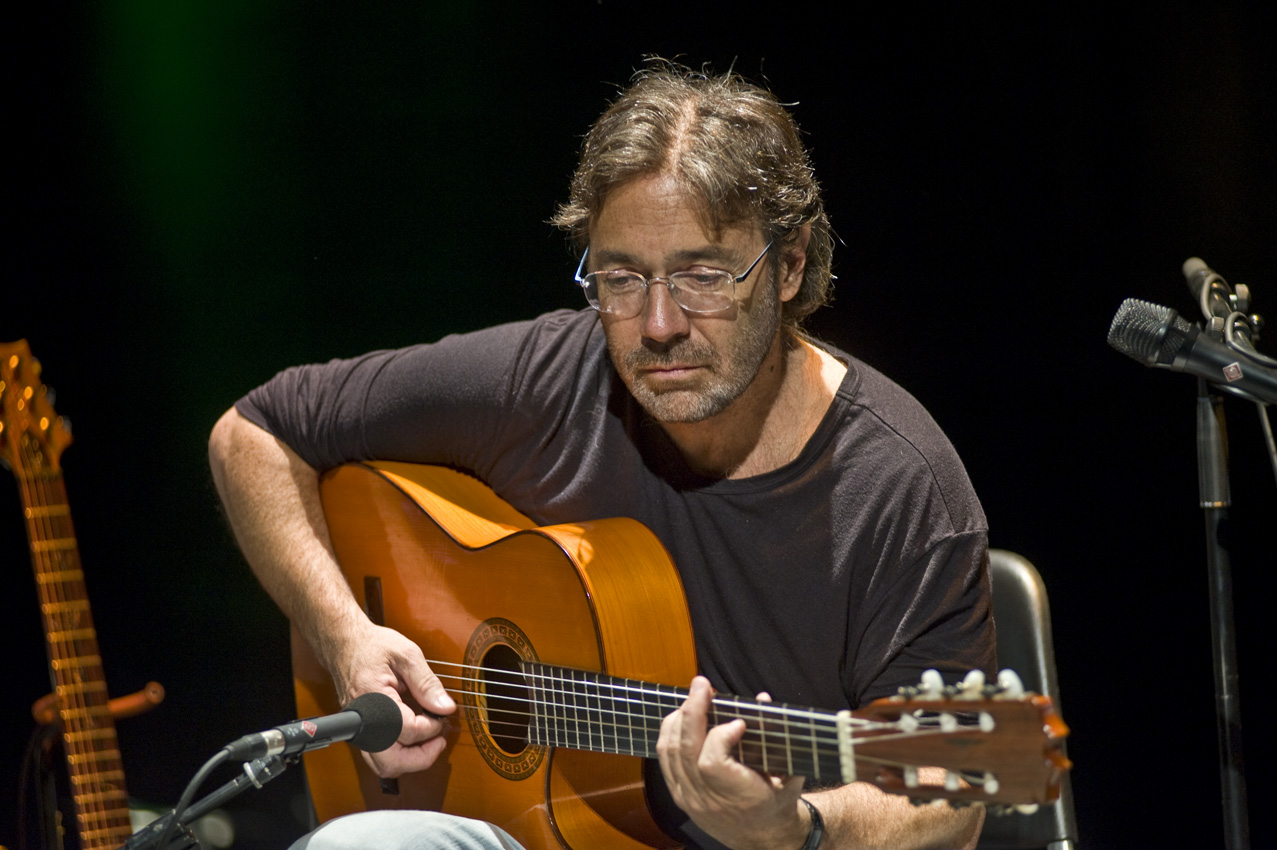
Al di Meola - Devil on Spanish guitar


Al Di Meola's continuous interest with complex cadenced syncopation joined with provocative expressive tunes and refined agreement has been at the core of his music all through a praised profession that has crossed four decades and earned him basic honors, three gold collections and more than six million in record deals around the world. A genuine guitar legend, perpetual survey victor, and productive author, he has amassed more than 20 collections as a pioneer while teaming up on twelve or so others with any semblance of the combination supergroup Return to Forever (with Chick Corea, Stanley Clarke and Lenny White), the praised acoustic Guitar Trio including kindred virtuosos John McLaughlin and Paco de Lucia, and the Rite of Strings trio with bassist Clarke and violinist Jean-Luc Ponty. And keeping in mind that his amazing procedure on both acoustic and electric guitars has managed him glorious status among the swarms of fretboard fan who consistently rush to his shows, the profundity of Di Meola's written work alongside the heartfelt quality and the natural lyricism of his guitaristic articulation have won him armies of fans worldwide past the guitar fan set.
A pioneer of mixing world music and jazz, backpedaling to early Latin-tinged combination trips like 1976's Land of the Midnight Sun, 1977's Elegant Gypsy and 1978's Casino, the guitar incredible keeps on investigating the rich impact of flamenco, tango, Middle Eastern, Brazilian and African music with his World Sinfonia, an eager dish worldwide gathering that he framed in 1991. Their thrilling world music combination has been reported on such discharges as 2000's The Grande Passion (including the Toronto Symphony Orchestra), 2007's Live in London, 2011's Pursuit of Radical Rhapsody and the shocking 2012 DVD, Morocco Fantasia (recorded at the Mawazine Festival in Rabat, Morocco and highlighting extraordinary visitors Said Chraibi on oud, Abdellah Meri on violin and Tari Ben Ali on percussion). Experiencing childhood in Bergenfield, NJ with the music of Elvis Presley, The Ventures and The Beatles, Di Meola normally inclined toward guitar as an adolescent and by his initial teenagers was at that point a proficient player. Achieving such amazing aptitudes at such a youthful age didn't come simple for Al, but instead was the aftereffect of centered devotion and escalated times of woodshedding between his lesser and senior years in secondary school. "I used to hone the guitar eight to ten hours per day," he disclosed to Down Beat. "Also, I was endeavoring to get myself, or locate the sort of music that suited where I was running with the guitar." His soonest good examples in jazz included guitarists Tal Farlow and Kenny Burrell. In any case, when he found Larry Coryell, whom Al would later name "The Godfather of Fusion," he was brought with the guitarist's remarkable mixing of jazz, blues and shake into one consistent vocabulary on the instrument. "I used to ride the transport from New Jersey to see him at little clubs in Greenwich Village," he reviews. "Wherever he was playing, I'd be there."  In 1972, Al selected at the Berklee College of Music in Boston and by the second semester there started playing in a combination group of four drove by keyboardist Barry Miles. At the point when a gig tape of that band was later passed on to Chick Corea by a companion of Al's in 1974, the 19-year-old guitarist was tapped to join Corea's combination supergroup Return to Forever as a swap for guitarist Bill Connors. After three milestone chronicles with Return to Forever - 1974's Where Have I Known You Before, 1975's Grammy Award winning No Mystery and 1976's Romantic Warrior - the gathering disbanded and Al consequently began up his profession as a performance craftsman. His 1976 introduction as a pioneer, Land of the Midnight Sun, was a blasting exhibit of his mark slashes and Latin-tinged organizations that highlighted a stellar cast including drummers Steve Gadd and Lenny White, bassist Anthony Jackson and Jaco Pastorius, keyboardists Jan Hammer, Barry Miles and Chick Corea and percussionist Mingo Lewis. Through the span of six more collections with Columbia Records – Elegant Gypsy, Casino, Splendido Hotel, Electric Rendezvous, Tour De Force and Scenario – Al set up himself as a compelling power in contemporary music. 1980 denoted the triumph of the acoustic guitar trio with Paco De Lucia and John McLaughlin. Their presentation recording on Columbia Records, Friday Night in San Francisco, turned into a point of interest recording that outperformed the four million check in deals. The next year, 1981, Di Meola was drafted into Guitar Player's Gallery of Greats after five back to back wins as Best Jazz Guitarist in the magazine's Readers Poll and winning best collection and acoustic guitarist for an aggregate of a record eleven wins. The three virtuosos in the trio visited together from 1980 through 1983, discharging the studio collection Passion, Grace and Fire in 1982. In 1995, they rejoined for a third account, Guitar Trio, take after by another triumphant world visit. In mid 1996, Di eola shaped another trio with the violinist Jean-Luc Ponty and RTF bandmate Stanley Clarke called The Rite of Strings. Their self-titled introduction was discharged in 1995. Di Meola thusly recorded with any semblance of musical drama hotshot Luciano Pavarotti, pop stars Paul Simon, established guitarist Manuel Barrueco, and Italian pop star Pino Daniele. Through the span of his profession, he has likewise worked and recorded with Phil Collins, Carlos Santana, Steve Winwood, Wayne Shorter, Tony Williams, Herbie Hancock, Gonzalo Rubalcaba, Milton Naciemento, Egberto Gismonti, Stevie Wonder, Les Paul, Jimmy Page, Steve Vai, Frank Zappa and Cuban piano player Gonzalo Rubalcaba. Di Meola's 2013 release All Your Life was an acoustic visit de constrain that made them return to the music of a fundamental impact – The Beatles. "I truly credit the Beatles for the motivation behind why I play guitar," he says. "That was a noteworthy impetus for me to need to learn music, so their effect was truly solid." A virtual small time show of virtuosity, it includes the guitar incredible deciphering 14 well-known Beatles tunes in the stripped-down setting of entirely acoustic guitar.


Share/Bookmark

george benson the king of jazz guitar

By the mid-to late-1970s, as he recorded for Warner Bros. Records, a radical new group of onlookers started to find Benson. With the 1976 discharge Breezin', Benson sang a lead vocal on the track "This Masquerade", which turned into an enormous pop hit and won a Grammy Award for Record of the Year. In 1976, George Benson showed up as a guitarist and reinforcement vocalist on Stevie Wonder's melody "Another Star" from Wonder's collection Songs in the Key of Life. He additionally recorded the first form of "The Greatest Love of All" for the 1977 Muhammad Ali bio-pic, The Greatest, which was later secured by Whitney Houston as "Most noteworthy Love of All". Amid this time Benson recorded with the German conductor Claus Ogerman. The live take of "On Broadway", recorded a couple of months after the fact from the 1978 discharge Weekend in L.A., likewise won a Grammy. He has worked with Freddie Hubbard on some of his collections all through the 1960s, 1980s.


The Qwest record mark (a backup of Warner Bros., keep running by Quincy Jones) discharged Benson's achievement pop collection Give Me The Night, delivered by Jones. Benson influenced it into the pop and R&B to top ten with the tune "Give Me the Night" (composed by previous Heatwave keyboardist Rod Temperton). He got many hit singles, for example, "Love All the Hurt Away", "Turn Your Love Around", "Inside Love", "Woman Love Me", "20/20", "Shudder", "Kisses in the Moonlight". All the more critically, Quincy Jones urged Benson to scan his foundations for advance vocal motivation, and he re-found his adoration for Nat Cole, Ray Charles and Donny Hathaway simultaneously, impacting a string of further vocal collections into the 1990s.
Benson was brought up in the Hill District in Pittsburgh, Pennsylvania. At seven years old, he initially played the ukulele in a corner tranquilize store, for which he was paid a couple of dollars. At eight years old, he played guitar in an unlicensed dance club on Friday and Saturday evenings, yet the police soon shut the club down. At 10 years old, he recorded his initially single record, "She Makes Me Mad", with RCA-Victor in New York, under the name "Little Georgie".
At 21 years old, he recorded his first collection as pioneer, The New Boss Guitar, highlighting McDuff. Benson's next chronicle was It's Uptown with the George Benson Quartet, including Lonnie Smith on organ and Ronnie Cuber on baritone saxophone. Benson lined it up with The George Benson Cookbook, likewise with Lonnie Smith and Ronnie Cuber on baritone and drummer Marion Booker. Miles Davis utilized Benson in the mid-1960s, including his guitar on "Stuff" on his 1968 Columbia discharge, Miles in the Sky before going to Verve Records.
Benson at that point marked with Creed Taylor's jazz name CTI Records, where he recorded a few collections, with jazz heavyweights guesting, to some achievement, for the most part in the jazz field. His 1974 discharge, Bad Benson, moved to the best spot in the Billboard jazz graph.


Share/Bookmark

Paco de Lucia, famous flamenco guitar player

Francisco Sanchez Goméz, Paco de Lucia, was, and keeps on being, Spain's most universal flamenco guitarist. His Spanish guitar playing is known to express the enthusiasm and conclusions of both Andalusia and Spain. His most celebrated melody "Between Two Waters" (Entre dos Aguas) is a standout amongst the most perceived Spanish traditional guitar tunes on the planet. Paco de Lucia, child of a Spanish father and a Portuguese mother (Lucia Gomes), was conceived in Algeciras, Cadiz (Spain) on December 21, 1947. In the area where the performer grew up there were numerous kids named "Paco" and "Pepe". Keeping in mind the end goal to recognize them, individuals started to reference whose tyke they were, for instance: "this is Lucia's Paco", which in Spanish is: "ese es Paco, de Lucía". This is the means by which the flamenco guitarist earned his creative name: Paco de Lucia. Paco de Lucia's dad and sibling, Ramon de Algeciras, another acclaimed guitar player who played with Paco for quite a while of his vocation, started to show him how to play the guitar at an early age. Paco's other sibling, Pepe de Lucia, is a well known cantaor, or flamenco artist, who has likewise teamed up with him professionally.
One of the features of Paco de Lucia's profession was in the 60's the point at which he teamed up with Camaron de la Isla, a standout amongst the most renowned flamenco artists. This was an incredible melodic union in Spain and brought about 10 fruitful records that speak to an unadulterated and conventional, yet unique Flamenco style. Their post 1977 work would develop, both together and independently, into a more well known flamenco style that joined shake, jazz and pop. Paco de Lucia's two greatest impacts were Niño Ricardo and Sabicas. Niño is another essential flamenco guitar player and Sabicas was the person who consummated the specialty of flamenco guitar playing. With the last mentioned, the guitar quit being only backup to the artist but instead a key figure in the flamenco execution. Sabicas likewise concocted two broadly utilized flamenco strategies: the alzapúa rope strategy and a three finger strumming method. The universal ubiquity that Paco de Lucia provided for the flamenco world is viewed as his greatest commitment. He could advance flamenco in different nations in view of his blended melodic style and joining of different rhythms into customary flamenco. His work opened the way to new melodic examinations in flamenco of extraordinary aesthetic quality. Paco's own style is described by his excellent virtuosity of guitar playing and solid, musical yet exceptional style that can be delighted in huge numbers of his exhibitions like "Entre dos aguas", "La Barrosa", "Barrio la Viña", "Homenaje al Niño Ricardo", "Almoraima", "Guajiras de Lucía" and "Río Ancho". In one of Paco de Lucia's many outings to Latin America towards the finish of the 70s, he met Carlos "Caitro" Soto de la Colina in Peru, an afro-Peruvian artist and cajón box drum percussion master. Paco de Lucia perceived that the cajón box drum could take care of a percussion issue that flamenco music continually experienced. So he, with the assistance of Rubem Dantas, acquainted the instrument with the other regular flamenco percussion instruments and from that minute the cajón box drum turned into a vital instrument in current flamenco. In 1992 Paco de Lucia endured a severe misfortune with the demise of Camaron de la Isla, with whom he had shared to such an extent. In 1998, he made one of his perfect works of art, a collection called Luzía, that he created amid his mom's long sickness that would in the long run outcome in her demise. He committed the collection to her. In the year 2004, Paco de Lucia got the Prince of Asturias Award, a lofty Spanish acknowledgment. The representative who gave him the honor clarified that "everything can be communicated with the 6 lines of the guitar in Paco's grasp". Shockingly, on 25 February 2014, Paco de Lucía passed far from a heart assault while traveling in Mexico. This particular artist will be remembered fondly yet luckily we have his chronicles to go with us into what's to come.

Share/Bookmark